Understanding Transistors: NPN vs PNP and Their Applications
Components • Jun 26, 2026
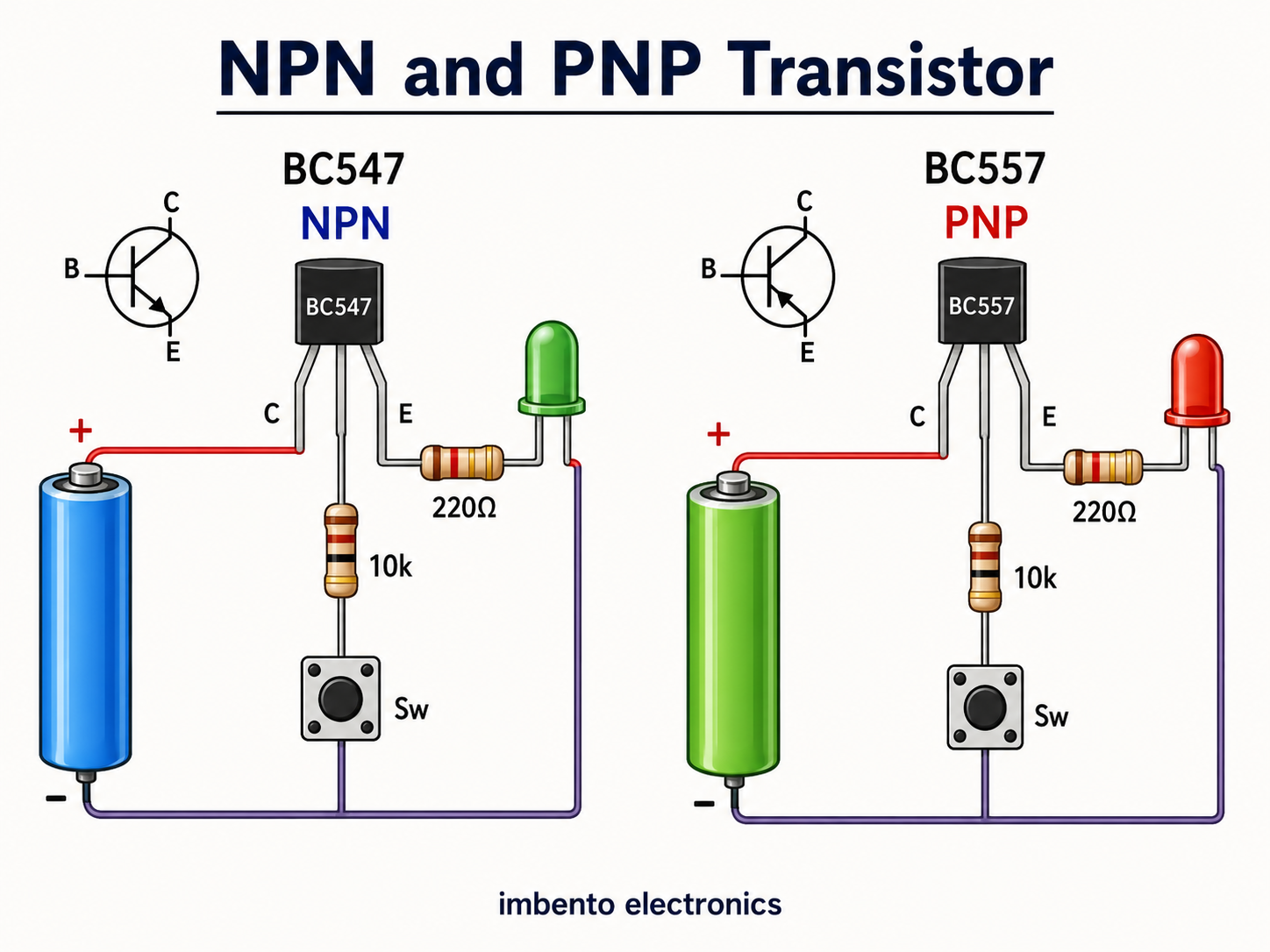
What is a Transistor and Why is It Important?
A transistor is a semiconductor device that can act as a switch or amplifier in electronic circuits. It is fundamental to modern electronics, allowing for signal modulation and power regulation.
Transistors are crucial in various applications, including:
- Amplification: Boosting signals in audio equipment.
- Switching: Enabling or disabling parts of a circuit efficiently.
- Computing: Acting as binary switches in digital devices.
Without transistors, many technologies we take for granted, such as computers and smartphones, would not exist.
Types of Transistors: NPN and PNP
Transistors are primarily ca
tegorized into two types: NPN and PNP. Understanding these types is crucial for effective circuit design.
NPN Transistor
An NPN transistor consists of two n-type semiconductors separated by a p-type semiconductor. Current flows from the collector to the emitter when a suitable voltage is applied to the base.
Characteristics of NPN transistors:
- Operates with a positive voltage applied to the collector.
- Ideal for high-speed switching applications.
- Commonly used in digital circuits.
PNP Transistor
A PNP transistor is the opposite of an NPN, featuring two p-type semiconductors separated by an n-type semiconductor. Here, current flows from the emitter to the collector when a sufficient voltage is applied to the base.
Characteristics of PNP transistors:
- Operates with a negative voltage applied to the collector.
- Useful in low-voltage applications.
- Commonly found in amplification circuits.
Differences Between NPN and PNP
The key differences between NPN and PNP transistors are:
- NPN transistors require positive voltage at the collector, while PNP requires negative voltage.
- In NPN, current flows from the collector to the emitter; in PNP, it flows from the emitter to the collector.
- NPN is typically preferred in digital circuits due to faster switching speeds.
How to Use Transistors in Your Projects
Transistors can be used in various applications, including amplifiers, switches, and signal modulators. Here’s how to effectively implement NPN and PNP transistors in your projects:
Using NPN Transistors
To use an NPN transistor, follow these steps:
- Select an appropriate NPN transistor based on current and voltage ratings.
- Connect the collector (C) to the positive voltage supply.
- Connect the emitter (E) to the load or ground.
- Apply a small voltage (VBE) to the base (B) to control the flow of current.
Using PNP Transistors
Similarly, to use a PNP transistor:
- Select a suitable PNP transistor.
- Connect the emitter (E) to the positive voltage supply.
- Connect the collector (C) to the load.
- Apply a small voltage (VBE) to the base (B) to allow current flow.
When to Use NPN vs. PNP
Choosing between an NPN and a PNP transistor can depend on various factors:
- Power Supply: Use NPN for positive supply voltages and PNP for negative.
- Type of Application: NPN is generally faster, while PNP may be preferable in low-voltage applications.
- Signal Type: Consider the type of signal you are working with.
In conclusion, understanding the operation of NPN and PNP transistors is vital for anyone involved in electronics. These components are powerful tools for circuit design, enabling a wide range of applications from simple projects to complex systems. Familiarizing yourself with their characteristics and the right usage scenarios will undoubtedly enhance your electronics skills.